NTV-IPS Phase Inversion Process
Casts an asymmetric pore structure, producing self-supporting microfiltration hollow-fiber membranes (HF-MF).
Visual meaning: The changing pore pattern illustrates the concept of membrane structure formation through phase separation.
NTV-IPS Phase Inversion
mbranfiltra uses the NTV-IPS phase-inversion process to cast an asymmetric pore structure; this production and control technology is what allows the company to make self-supporting microfiltration hollow-fiber membranes (HF-MF). The illustration below shows the spinning line used for it.
Hollow-Fiber Membrane Manufacturing (Illustration)
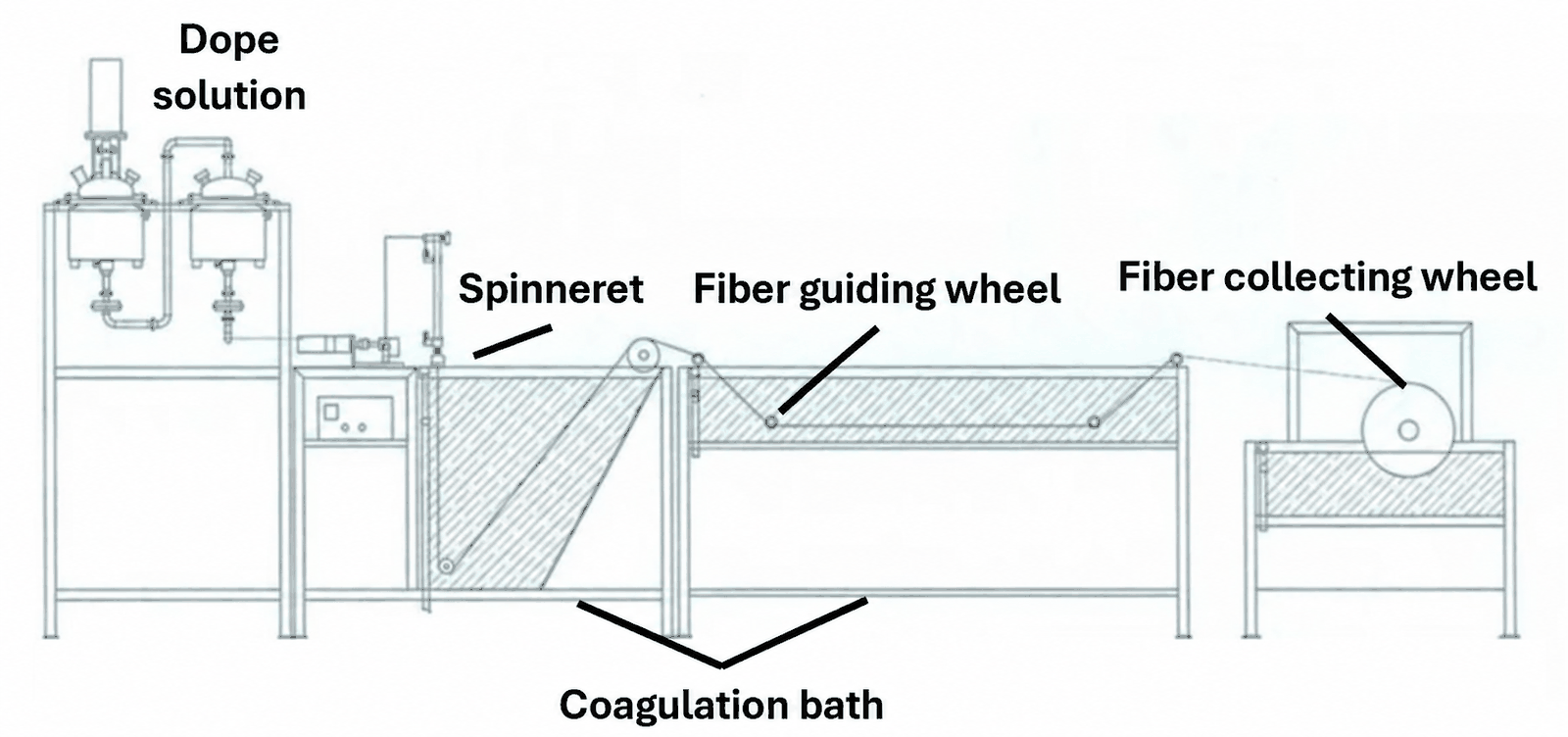
- Dope solution
- Spinneret
- Coagulation bath
- Fiber guiding wheel
- Fiber collecting wheel
Membrane Platform
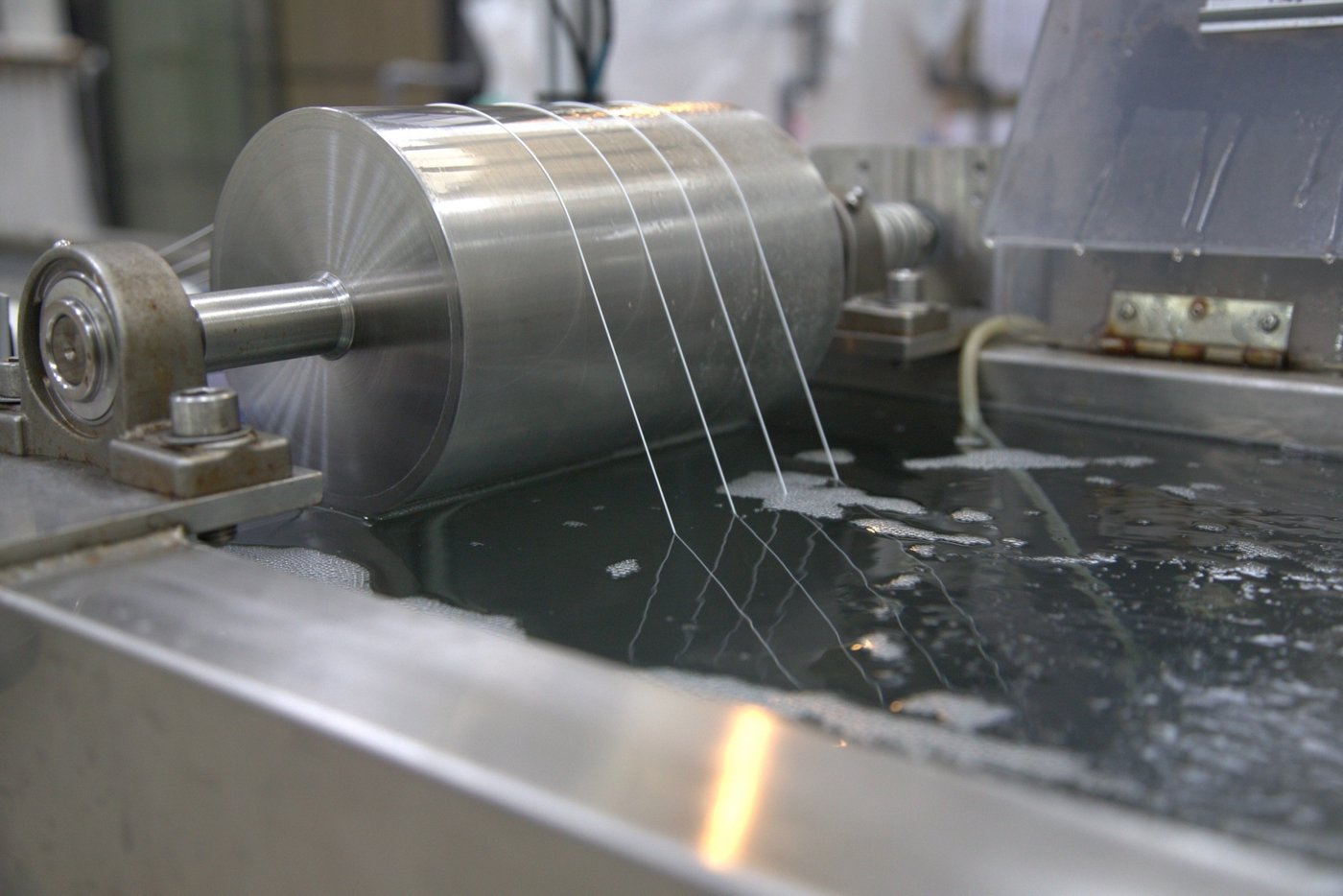
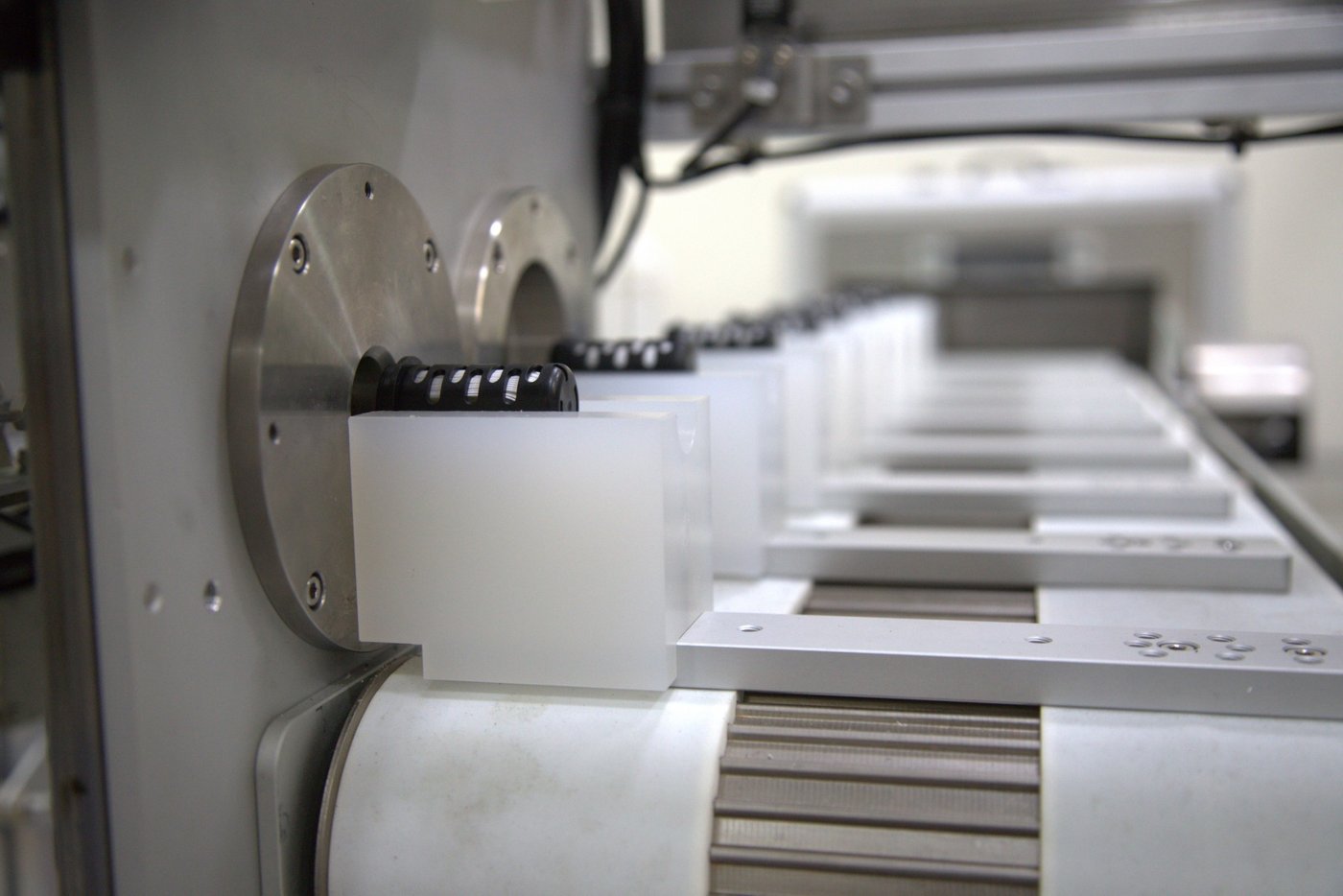
mbranfiltra produces microfiltration hollow-fiber membranes (HF) in hydrophobic and hydrophilic types for many industries, and supplies the fibers to filter-module and cartridge manufacturers to build into their own end products. Microfiltration hollow-fiber membranes are the main product; they can be packaged into cartridges of many sizes, and new formats are developed flexibly with customers.
See the cartridge and housing spec sheets on the Products page →
Materials: PES / Nylon / PVDF / PP
Hydrophobic and hydrophilic membranes made from several polymers to meet diverse market needs. Pore size, flux and suitable conditions vary by model — request technical data for specifications.
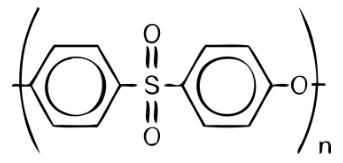
PES
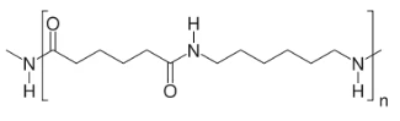
Nylon
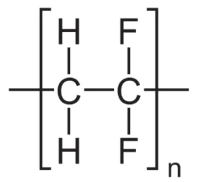
PVDF
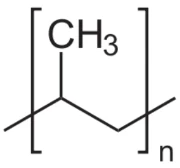
PP
Chemical structure diagrams, illustrative only.
Published data by product
Only figures printed on the catalog images are listed; each row links to its original image. "Not listed" means the image gives no such figure — ask for data rather than assume.
Hollow-fiber membrane products (catalog)
| Product | Material | Rating | Temperature | Operating pressure | Source |
|---|---|---|---|---|---|
| Household acorn-shaped cartridge | MaterialPES | Rating0.2 μm | Temperature operating 4–40°C | Operating pressure1–4 kg/cm² | Source Catalog image ↗ |
| Household cartridge-style filter | MaterialPES | Rating0.2 μm | Temperature operating 4–40°C | Operating pressure1–4 kg/cm² | Source Catalog image ↗ |
| Household composite cartridge (with activated carbon) | MaterialPES | Rating0.2 μm | Temperature operating 4–40°C | Operating pressure1–4 kg/cm² | Source Catalog image ↗ |
| 10-inch standard filter | MaterialPES | Rating0.2 μm | Temperature operating 10–65°C | Operating pressure1–5 kg/cm² | Source Catalog image ↗ |
All four are PES hollow-fiber products. For Nylon, PVDF and PP hollow-fiber membranes the company has not published pore size, pH or temperature figures. Related products →
Pleated and melt-blown cartridges in the catalog (not hollow-fiber)
| Product | Material | Rating | pH | Temperature | Source |
|---|---|---|---|---|---|
| PES pleated cartridge | MaterialPES | Rating0.05–1.2 μm | pH2–13 | Temperature max 80°C | Source Catalog image ↗ |
| Nylon pleated cartridge | MaterialNylon | Rating0.1–5 μm | pH6–14 | Temperature max 80°C | Source Catalog image ↗ |
| PVDF pleated cartridge | MaterialPVDF | Rating0.1 / 0.22 / 0.45 μm | pH1–13 | Temperature max 90°C | Source Catalog image ↗ |
| PP pleated cartridge | MaterialPP | Rating0.1–50 μm | pH1–13 | Temperature max 80°C | Source Catalog image ↗ |
| PP melt-blown cartridge | MaterialPP | Rating0.5–50 μm | pH Not listed | Temperature max 60°C | Source Catalog image ↗ |
| PP industrial melt-blown cartridge | MaterialPP | Rating0.5–50 μm | pH Not listed | Temperature max 70°C | Source Catalog image ↗ |
Each row is a separate cartridge product; its figures describe that cartridge only, not a hollow-fiber membrane of the same material. Related products →
How It Works
Pore Barrier
The hollow-fiber wall has countless small pores that physically block bacteria and particles larger than the pore size. Microfiltration does not remove dissolved substances such as salts or dissolved chemicals, so the output is not "pure water".
Difference from Reverse Osmosis
Reverse osmosis concentrates wastewater, so a share of it must be discharged. Hollow-fiber microfiltration filters the water as it passes through the membrane, needs no electricity and uses all of the water that passes through; figures depend on the model. Microfiltration does not remove dissolved salts as reverse osmosis does.
What It Filters
Bacteria, microorganisms and microplastics are contaminants commonly met in outdoor drinking water. Third-party test results cover E. coli only, for specific samples and dates (see below); there is no report for microplastics or other microorganisms.
Lab & Testing
Has a capillary flow porometer (CFP), water-quality analyzer and other specialized equipment, and offers analysis of customer materials and water samples.
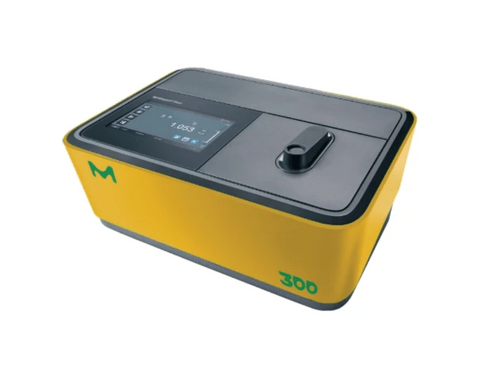
Water quality analyzer (equipment maker's product image, not a photo of our lab).
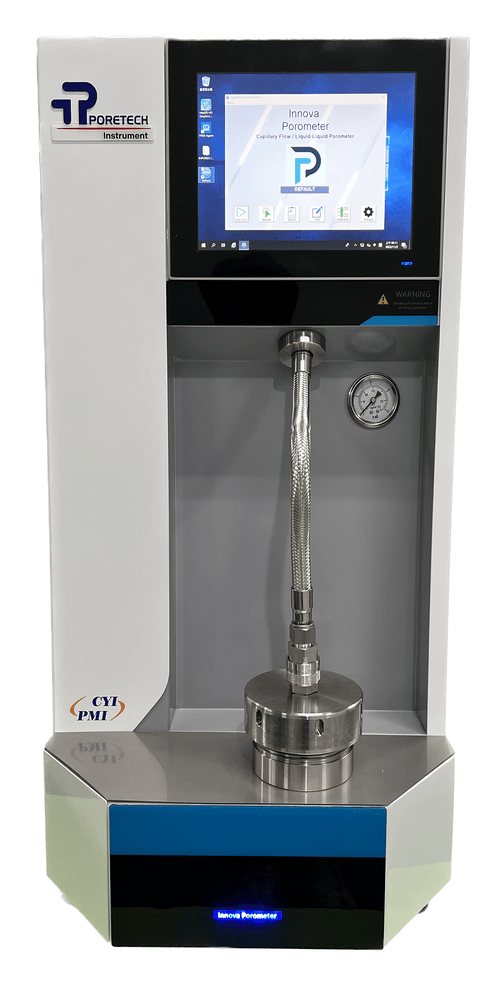
Capillary flow pore size analyzer (CFP) (equipment maker's product image, not a photo of our lab).
| Test | Result |
|---|---|
| SGS test report | Per SGS report PX/2020/A011301 (sample MF02-M1, 2020-10-23): E. coli removal rate above 99.9%. Applies to this sample only, not the whole product line. |
| ISO 10993-5 | Cytotoxicity test, per report M62-200500018001 (ISO 10993-5, 2020-05): grade 2/mild, 22.2% viability reduction — not cytotoxic under the test conditions. Applies to this sample only. |
| BENQ test report | Per BenQ Dialysis Technology report BDT-NT-231207 (sample MF002, 2023-12-20): E. coli clearance rate above 99.9%. Applies to this sample only, not the whole product line. |
| Taiwan–US inspection | Per Taiwan–US Testing Technology (SUPERLAB) report M61-200200105 (mfd. 2019/12, 2020-02-13; pages 1–2 of the same 5-page report): no residual plasticizers or heavy metals detected. Applies to this sample only, not the whole product line. |
Report number, tested sample, date and method are shown with each report scan below. Each result applies only to the specific sample and date tested, not a blanket guarantee across the whole product line; the two Taiwan–US results below are two pages of the same 5-page report, not two separate tests.
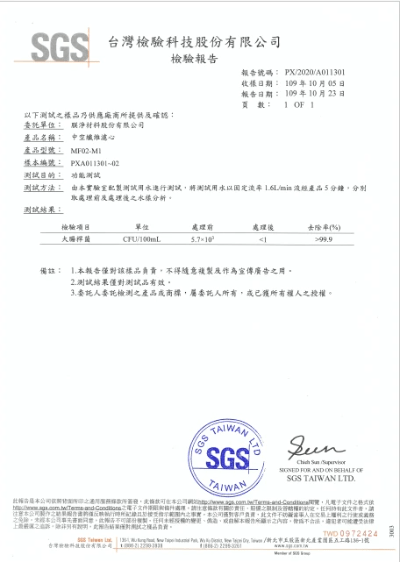
SGS Test Report No. PX/2020/A011301 — sample MF02-M1, tested 2020-10-23. Water filtered at 1.6 L/min for 5 min; E. coli reduced from 5.7×10³ to <1 CFU/100mL (removal rate >99.9%).
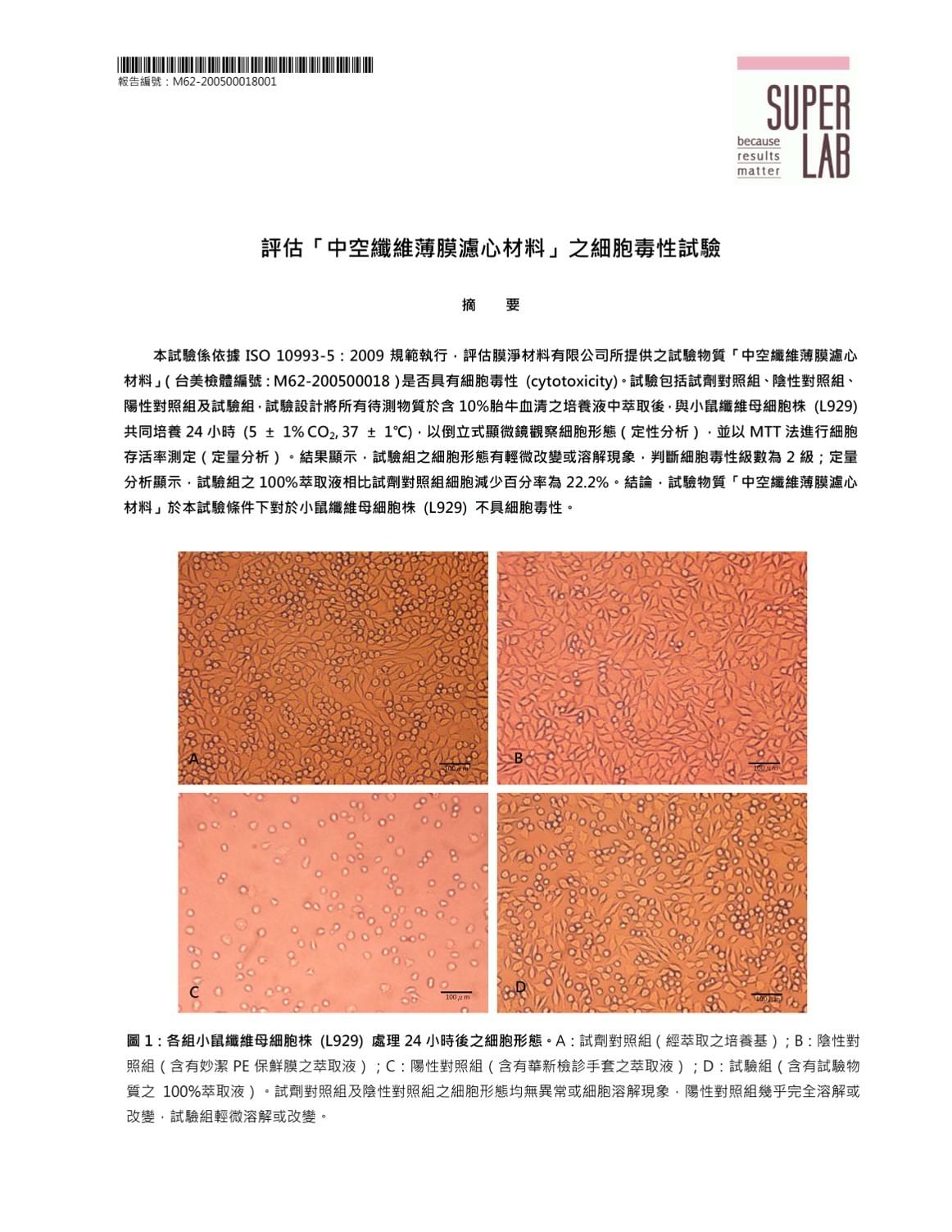
Cytotoxicity Test Report No. M62-200500018001 (per ISO 10993-5:2009) — sample: hollow-fiber membrane cartridge material (no specific model stated), tested 2020-05. MTT assay + morphology on L929 mouse fibroblasts, 24 h co-culture with a 10% serum extract. Result: cytotoxicity grade 2 (mild); 100% extract reduced viability 22.2% vs. control. Conclusion: not cytotoxic under the test conditions.
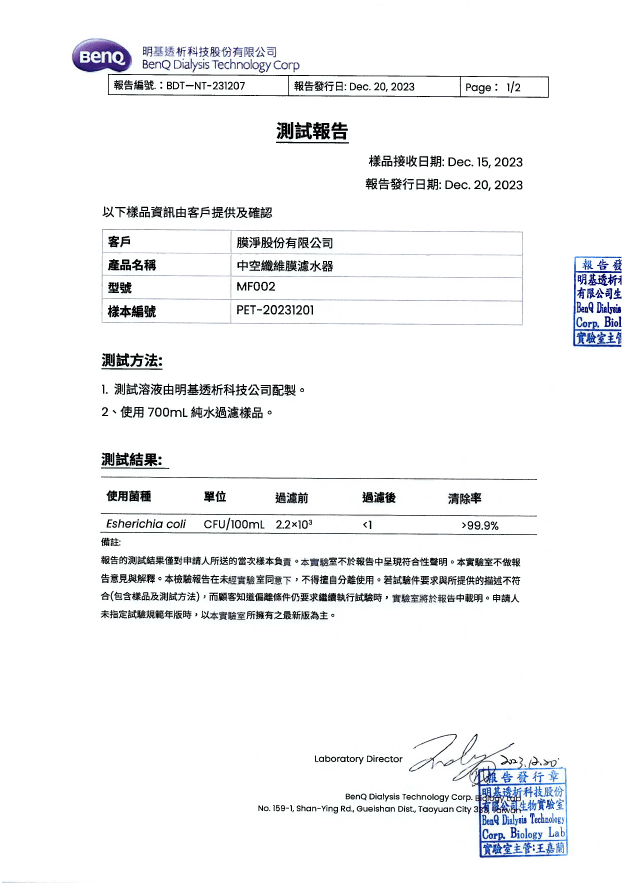
BenQ Dialysis Technology Test Report No. BDT-NT-231207 — sample MF002 (faucet-mounted purifier), tested 2023-12-20. 700 mL of pure water filtered through the sample; E. coli reduced from 2.2×10³ to <1 CFU/100mL (clearance rate >99.9%).
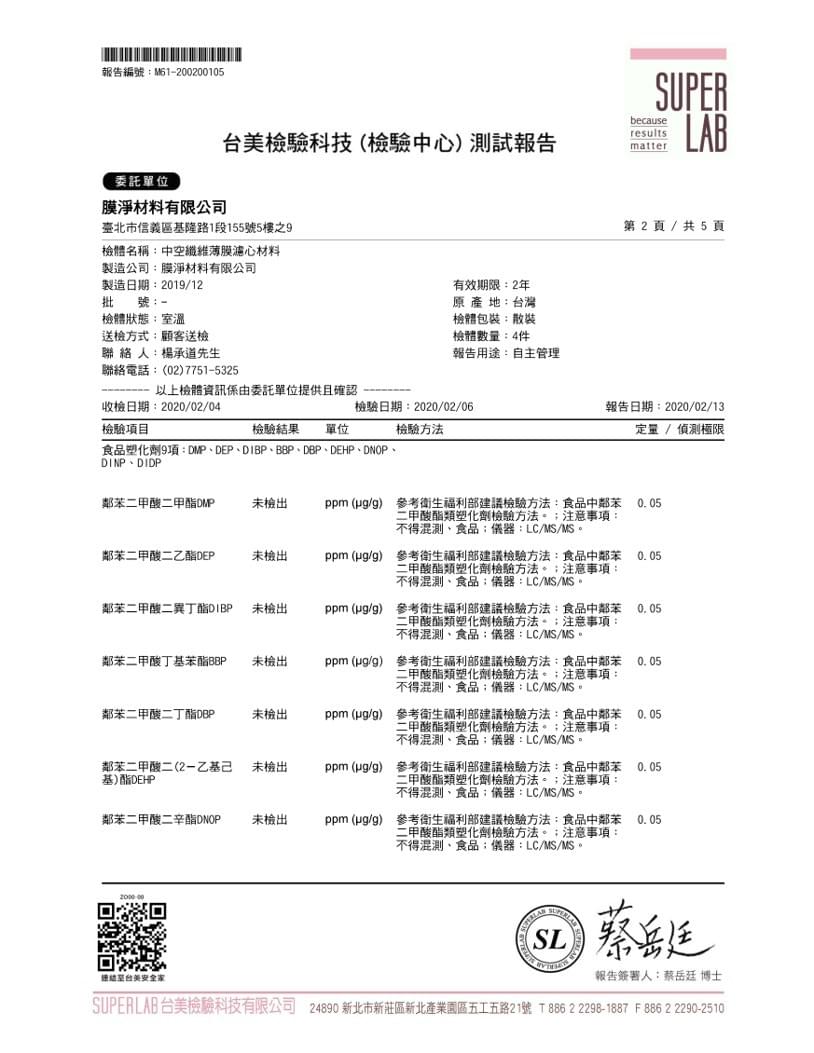
Taiwan-US Testing Technology (SUPERLAB) Report No. M61-200200105 (page 2 of 5) — sample: hollow-fiber membrane cartridge material, manufactured 2019/12 (no specific model stated), tested 2020-02-13. 9 plasticizers tested (DMP, DEP, DIBP, BBP, DBP, DEHP, DNOP, DINP, DIDP), detection limit 0.05 ppm. Result: none detected.
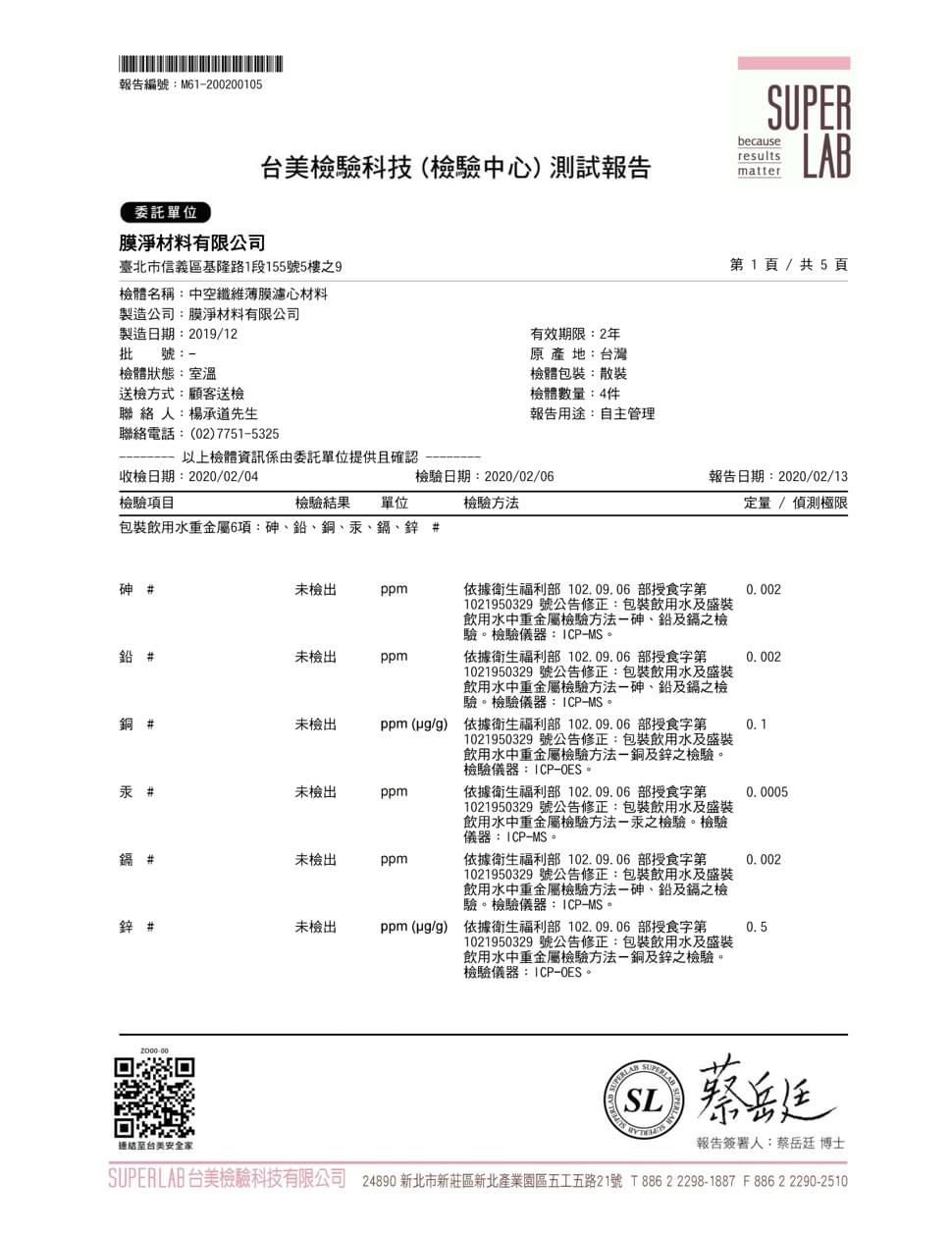
Taiwan-US Testing Technology (SUPERLAB) Report No. M61-200200105 (page 1 of 5 — the same report as the plasticizer result above) — same sample, tested 2020-02-13. 6 heavy metals tested (arsenic, lead, copper, mercury, cadmium, zinc). Result: none detected.
Documents on this page
Published here as scans: 4 third-party test reports — SGS PX/2020/A011301, BenQ Dialysis Technology BDT-NT-231207, SUPER LAB M61-200200105 and SUPER LAB M62-200500018001 (plus English-language versions); each applies to its tested sample only, not the whole product line (sample, date and scope for each are listed above). For ISO 9001 / ISO 13485 certificates, certificates of analysis (CoA) and safety data sheets (SDS), please ask what is available for your model.
| Document | Availability |
|---|---|
| SGS PX/2020/A011301 | Report scan published on this page (applies to the tested sample only) View ↓ |
| SGS PX/2020/A011305 | English-language scan, listed under its own report number View ↓ |
| BenQ BDT-NT-231207 | Report scan published on this page (applies to the tested sample only) View ↓ |
| SUPER LAB M61-200200105 | Report scan published on this page (applies to the tested sample only) View ↓ |
| SUPER LAB M61-200200105ENR01 | English-language scan, listed under its own report number View ↓ |
| SUPER LAB M62-200500018001 (ISO 10993-5) | Report scan published on this page (applies to the tested sample only) View ↓ |
| SUPER LAB M62-200500018001EN | English-language scan, listed under its own report number View ↓ |
| BenQ BDT-NT-250802 (MGN, 21 CFR 210.3(b)(6)) | Cited as text; the report itself is not reproduced (applies to the tested sample only) View → |
| ISO 9001 | Available on request — ask for your model Ask → |
| ISO 13485 | Available on request — ask for your model Ask → |
| CoA (MGN200-10F6T, LOT 241202001) | Example COA published (one lot; applies to that lot only) View → |
| SDS | Available on request — ask for your model Ask → |
English-language report scans
English versions of the same tests: SUPER LAB report M61-200200105ENR01 (revised English report replacing M61-200200105EN; pages 1–4 of 6 shown), SUPER LAB cytotoxicity report M62-200500018001EN (abstract, page 5 of 26), and an SGS report numbered PX/2020/A011305 (sample MF02-M1, received 2020-10-05, reported 2020-10-23, E. coli elimination >99.9%), listed under its own number. The SUPER LAB pages cover the same samples and dates as the reports above; each result applies to its tested sample only, not the whole product line.
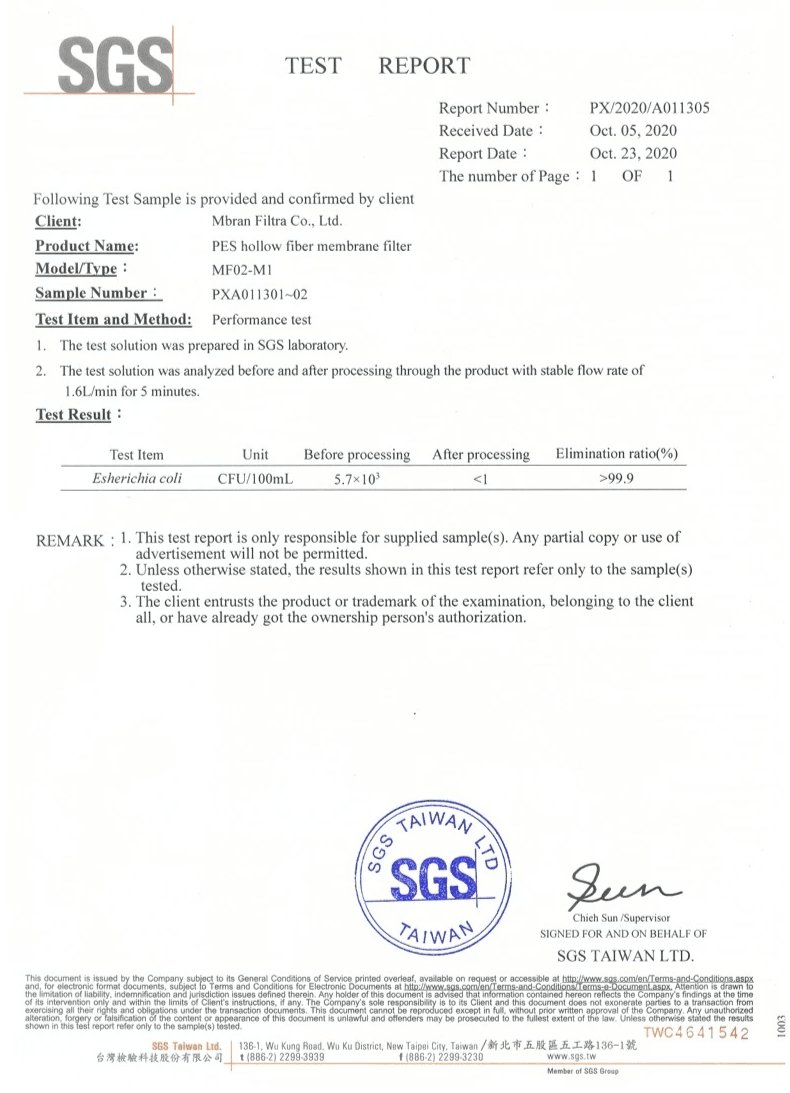 SGS PX/2020/A011305
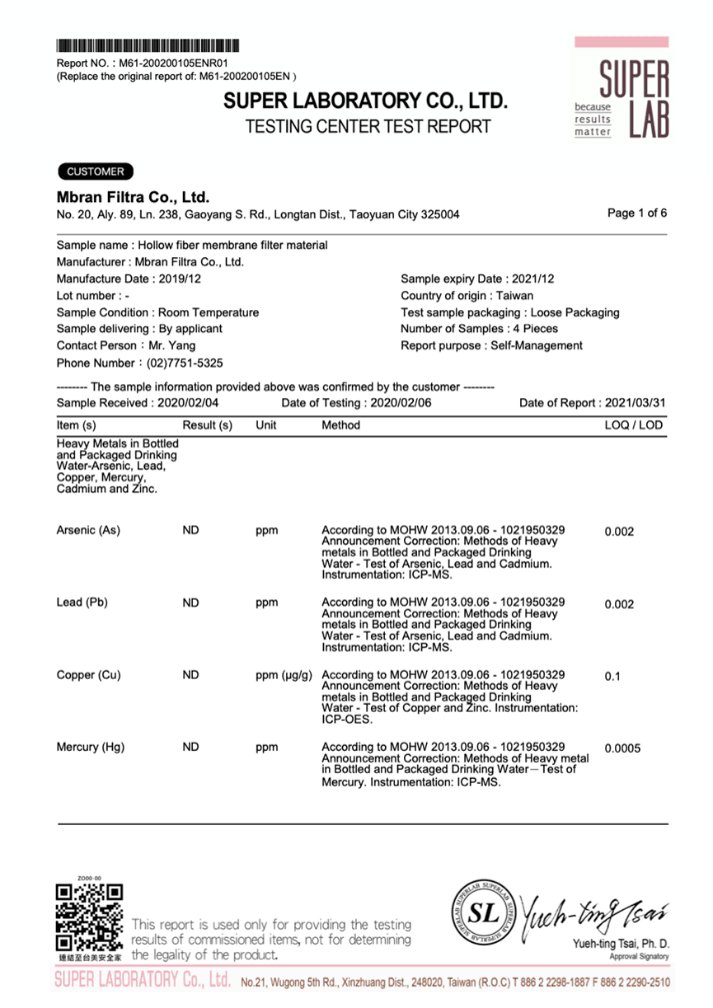 SUPER LAB M61-200200105ENR01 p.1/6
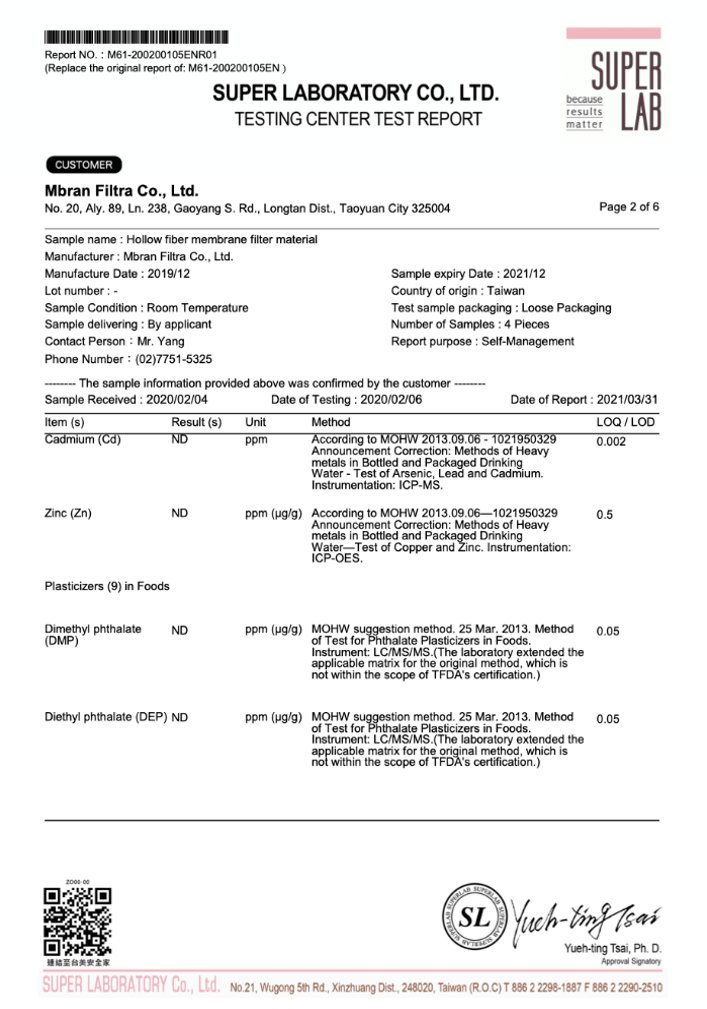 SUPER LAB M61-200200105ENR01 p.2/6
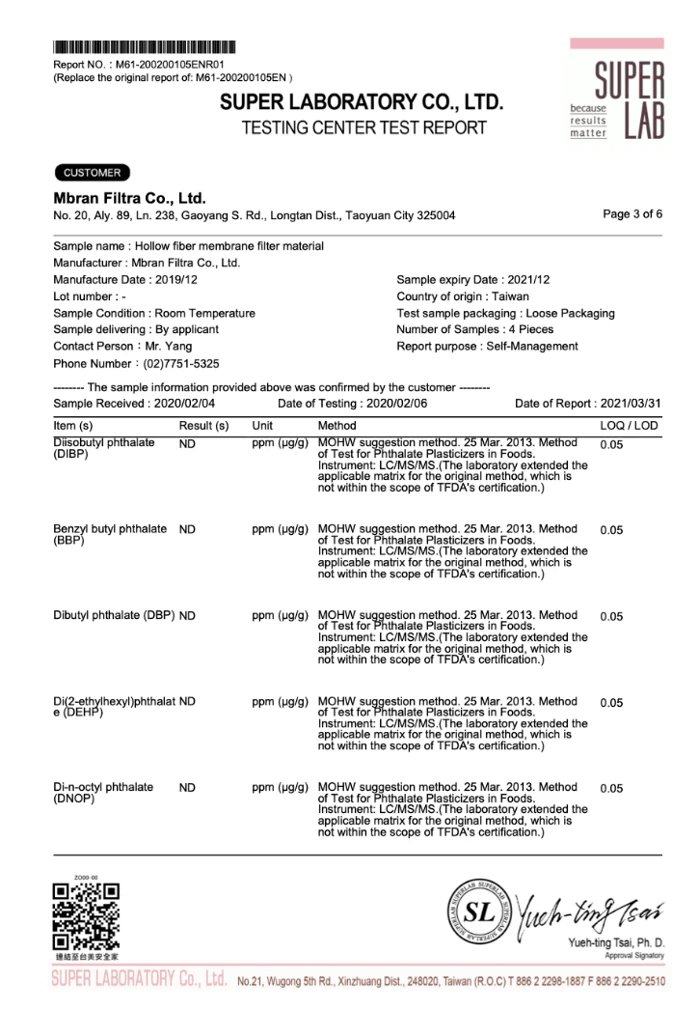 SUPER LAB M61-200200105ENR01 p.3/6
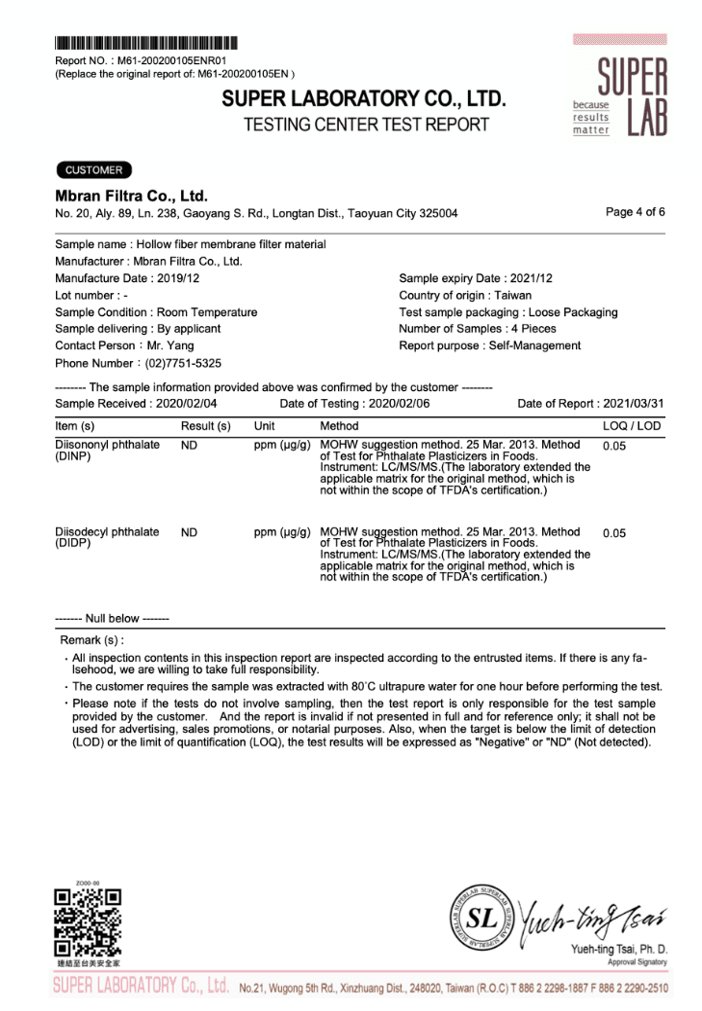 SUPER LAB M61-200200105ENR01 p.4/6
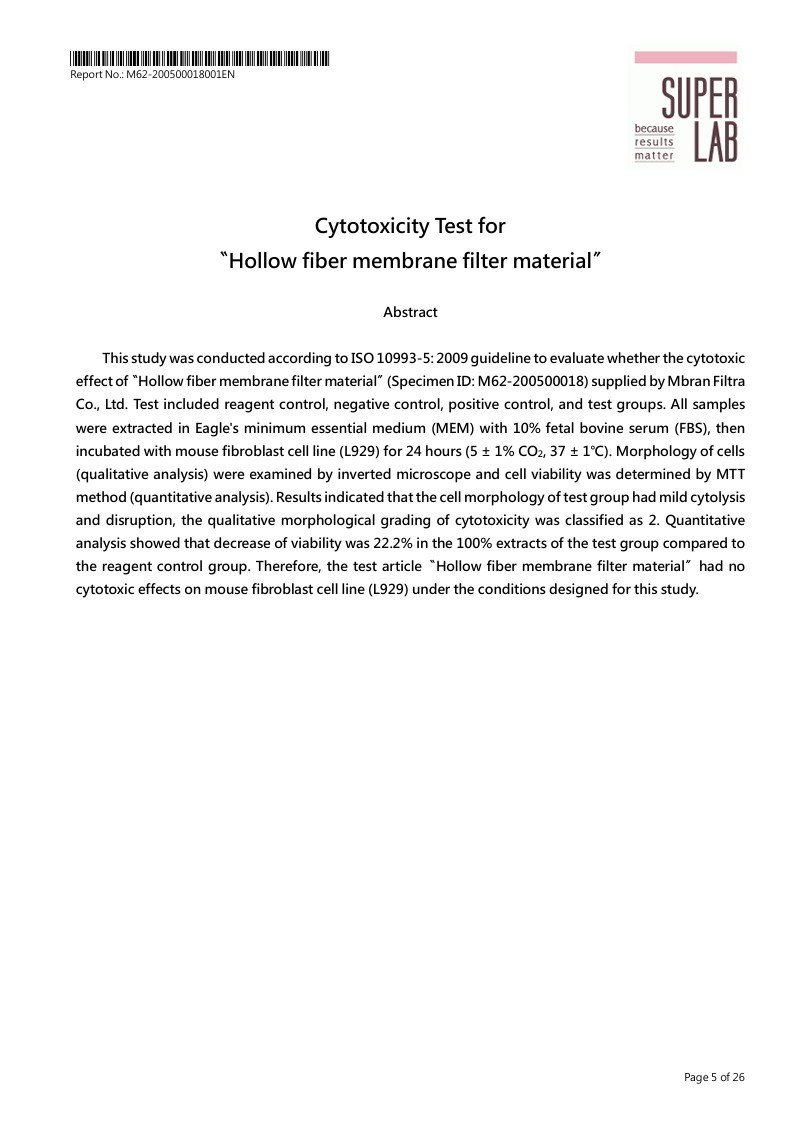 SUPER LAB M62-200500018001EN p.5/26
Need pore-distribution, flow-rate or lifetime figures? Please request technical data, and we will reply with what we can provide for your model and use.
Want to know more?
Tell us about your application, and we will reply with what we can provide.